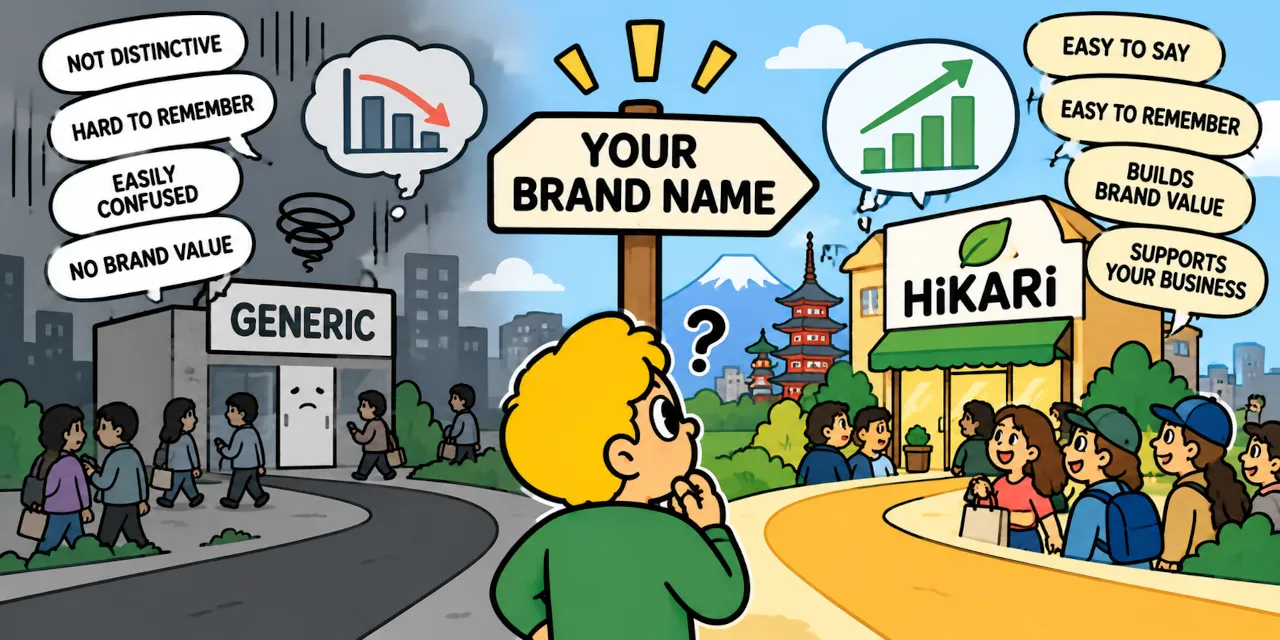
When starting a business, choosing a name is often treated as a creative decision, while trademark registration is treated as a legal procedure.
But a trademark is not merely something to protect after your business becomes successful. The name you choose influences your chances of success from the very beginning.
The wrong name can become a lasting burden on your business, costing far more than the professional fees and official costs of registering it.
Your Trademark Is a Multiplier on Your Marketing Investment
Think of your trademark as a multiplier on everything you spend on marketing.
And remember: that multiplier is not always greater than one. It can also be less than one.
Two businesses may offer equally good products, spend the same amount on advertising, and provide the same level of customer service. Yet their results can differ significantly, simply because of the names they use.
A good trademark helps customers remember a business, associate it with positive experiences, and recommend it to others. Even a modest marketing budget can turn into word of mouth, social media attention, and lasting recognition.
A poor trademark produces much weaker results. Customers remember the product or service but not who provided it, and the business must spend considerably more on advertising simply to maintain the same level of recognition.
The same investment does not produce the same return when the names are different.
This difference is not limited to a single campaign. As long as you use the same name, its strengths and weaknesses continue to affect the efficiency of every future investment. The relationship is not a fixed mathematical formula, since markets and customers change. But the name remains one of the factors that determine how efficiently your business builds lasting value.
The Cost of a Bad Trademark Can Be Enormous
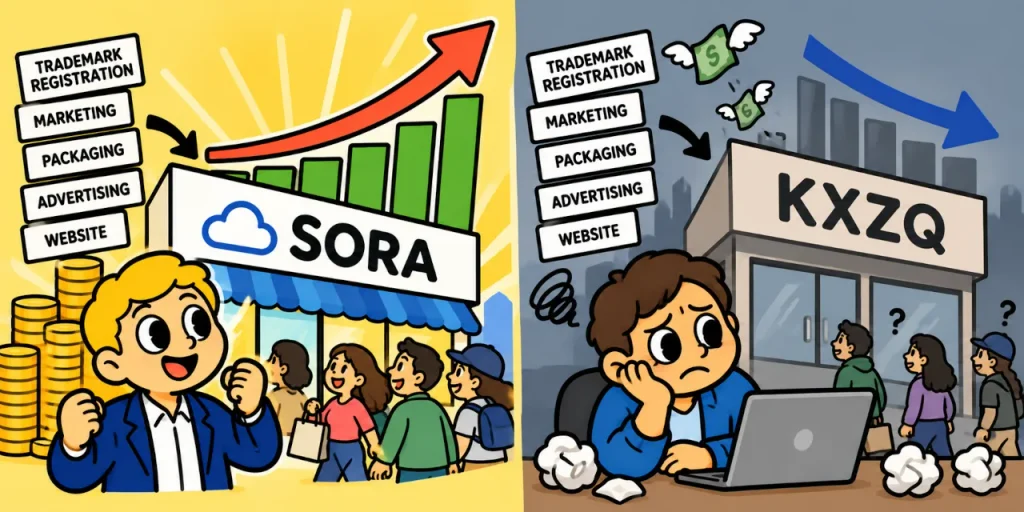
Trademark registration involves professional fees and government fees. These costs are small compared with the long-term consequences of choosing a poor name.
Imagine spending years promoting a business under a name that customers find difficult to remember or distinguish from competitors. You keep investing in advertising, packaging, and websites, yet struggle to build recognition that belongs specifically to you. Meanwhile, a competitor with a stronger name achieves better recognition with less effort.
There is also the problem of sunk costs. Once you have paid to register a trademark, you feel reluctant to abandon it. After all, you have already spent money protecting that name.
As your business grows, the investments tied to the name accumulate. Changing it means replacing packaging, updating websites, rebuilding customer recognition, and losing some of the goodwill you have already established. The more you invest, the harder it becomes to consider rebranding, even when changing the name would be the better business decision.
The greatest trademark risk is not losing the cost of registration. It is continuing to invest in a name that cannot build lasting brand value.
That is why choosing a good trademark at the very beginning is so important.
What Makes a Good Trademark?
My basic definition is simple:
A good trademark is a name that customers can easily remember as something unique, while associating it with a positive impression.
Several qualities contribute to this:
- Recognition and pronunciation: Customers should be able to recognize and pronounce the name without unnecessary difficulty.
- Memorability: The name should be easy to remember and communicate to others.
- Positive associations: The name should avoid unintended meanings or impressions that could harm the image of the products or services.
- Distinctiveness: Customers should be able to associate the name with a particular business rather than merely a category of products or services.
These qualities do not guarantee success. But they make it far easier to turn marketing efforts and positive customer experiences into lasting brand recognition.
A good trademark also does not need to describe what your business does. In fact, trying too hard to make a name descriptive can undermine it as a brand.
The SEO Keyword Trap
One naming strategy deserves particular caution: choosing a trademark primarily from the search keywords that potential customers use.
At first glance, this may seem like a smart marketing decision. If customers frequently search for certain words, why not build your brand name from those words?
Such a name may attract search traffic, especially when it closely matches the terms customers use. But being found through a search is not the same as being remembered as a brand.
A name built around common search terms tells customers what you sell without telling them who you are. They remember the product category rather than your business. Even if your advertising generates substantial traffic, that recognition does not accumulate as goodwill attached to your own name.
The law points in the same direction. Under Article 3(1)(iii) of the Japanese Trademark Act, a trademark consisting solely of a mark that describes the characteristics of goods or services in a common manner may be refused registration. Even where such a trademark is registered, Article 26 limits the effect of trademark rights over certain descriptive uses. In other words, registration does not give you exclusive control over ordinary descriptive language used by competitors.
The commercial problem is just as serious. If competitors adopt similar keyword-based names and spend more on advertising or search visibility, your apparent advantage disappears. Without a distinctive place in customers’ memories, there is little left to hold on to.
A keyword-based name may attract initial attention, but it is weak at accumulating long-term brand value.
Let Keywords Help Customers Find You
This does not mean you should avoid search keywords altogether.
Give your brand its own distinctive name, and use relevant keywords in your tagline, product descriptions, page titles, and other marketing content. A unique brand name with a clear subtitle or website description lets search visibility and brand distinctiveness each do their own job.
Let keywords help customers find you. Let your trademark help them remember you.
A Good Name Abroad May Not Work in Japan
All of this becomes even more important when you bring an existing brand into a new market.
A name that is easy to pronounce and remember in English may be difficult for Japanese consumers to read. It may be pronounced differently from what its owner intended, or it may resemble an unrelated, and sometimes unfortunate, Japanese word.
Even global companies face this. Google’s Gemini is pronounced “JEM-ih-nye” in English, but Japanese users read it as ジェミニ (je-mi-ni). In January 2026, Google Japan confirmed ジェミニ as the official Japanese notation of the name.
These differences are not linguistic curiosities. They affect how easily customers recognize, remember, search for, and recommend your business. A name that works efficiently in its home market can require substantially more marketing investment to achieve the same recognition in Japan. The multiplier can change when the name crosses a border.
This does not mean foreign businesses should automatically change their names when entering Japan. A consistent global identity has real value, and many foreign names work very well in Japanese. Sometimes the right answer is to keep the name and simply decide how it should be read in Japan. Sometimes the right answer is to reconsider the name altogether.
Our two fictional sample reports show both cases: [VITANOVA — Keep the Name, Change the Pronunciation] and [KUSORA — Reconsider the Name].
Choose a Name Worth Investing In
A successful business can make a trademark valuable. But the reverse is also true: a well-chosen trademark can help make a business successful.
The name you choose influences how efficiently your marketing generates recognition, how easily customers recommend you, and how effectively positive experiences become lasting goodwill. These effects continue for as long as you use the name.
No trademark can guarantee success, and no naming evaluation can eliminate every business risk. Product quality, pricing, customer service, and strategy remain essential. Nevertheless, choosing a trademark is one of the earliest decisions a business makes, and one whose consequences last for years.
At Rights Plus IP Office, we believe that choosing a name deserves at least as much attention as registering it. Our goal is not simply to help businesses obtain trademark rights in Japan, but to help them decide whether their names are worth the long-term investment a brand requires.
Don’t just ask, “Can I register this trademark?”
Ask, “Is this a name worth investing in for years to come?”
If you are bringing your brand to Japan, our [Japan Brand Fit Check] examines how your name is likely to be read, pronounced, remembered, and perceived by Japanese consumers, before you commit to it.
Because protecting a name matters — but choosing a name worth protecting matters even more.